
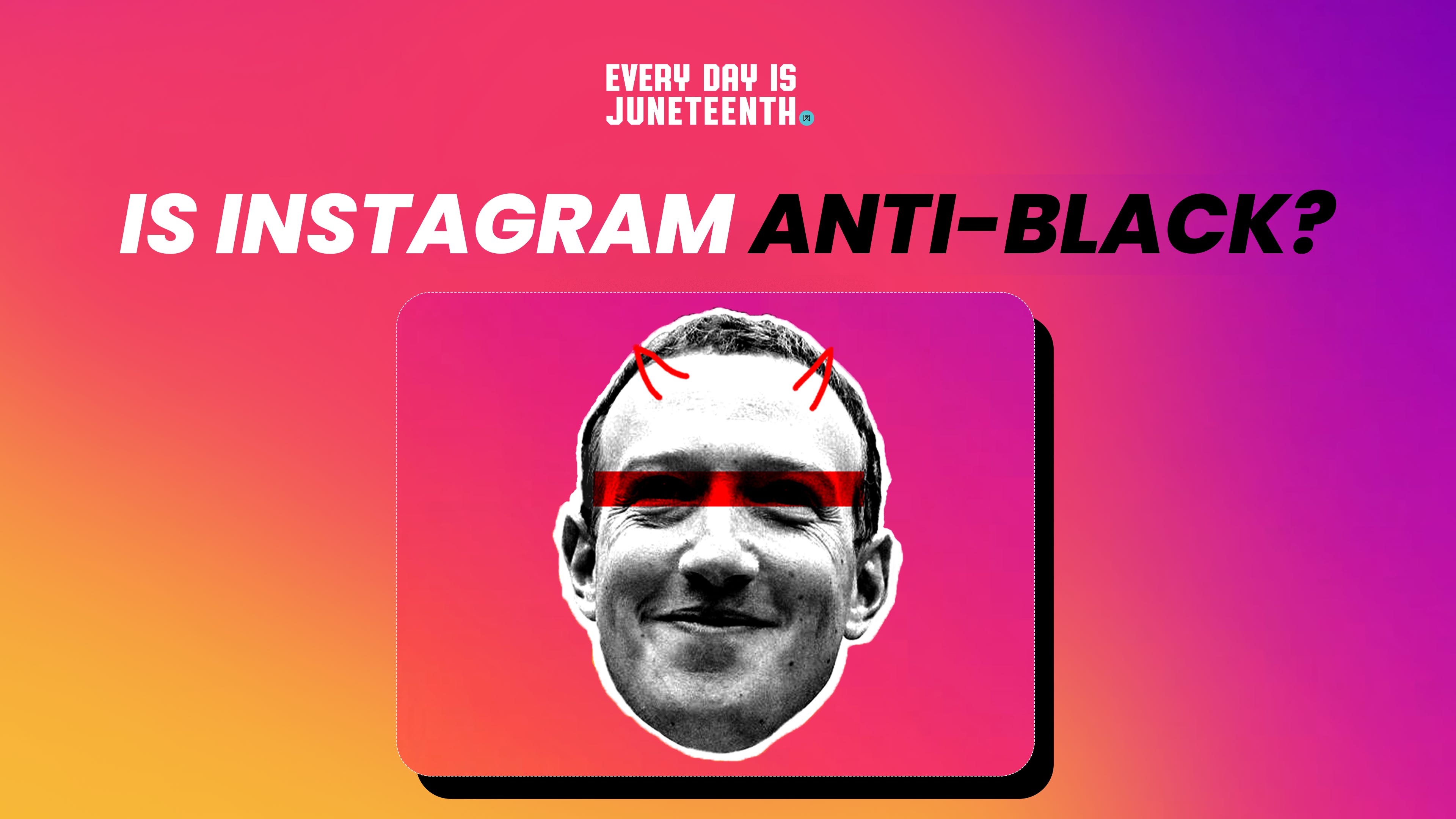
Is Instagram Anti-Black?
by Mr. Well-Travelled

Since March 2024, the Every Day Is Juneteenth account on Instagram has repeatedly faced prolonged shadowbanning, relentless attacks from white supremacist trolls and bots in our comments, content suppression and deletion, and repeated account restrictions due to alleged violations of Instagram’s Community Guidelines. Unfortunately, our experience is far from isolated.
Over the past decade, Black creators have repeatedly documented patterns of suppression, demonetization, and silencing on Instagram. These experiences are not anecdotal. They have been consistently validated by investigative journalism and academic research.
Here’s a breakdown of what we know, organized into 10 critical questions and answers that expose the platform’s role in sidelining and suppressing Black creators:
1. Is Instagram inherently anti-Black?
While the technology Instagram uses to operate isn’t designed to be anti-Black, evidence suggests that its human-designed algorithms and human-designed moderation practices disproportionately disadvantage Black users. This reflects broader systemic biases present in society and technology.
2. How does Instagram’s “shadowbanning” affect Black creators?
Black creators often report reduced visibility of their content without clear violations of community guidelines — a phenomenon known as “shadowbanning.” A 2024 University of Michigan study found that marginalized groups, including Black users, disproportionately experience such restrictions, leading to decreased engagement and reach.
3. Is there data showing disproportionate account suspensions specifically for Black users?
Yes. A 2020 report from Business Insider revealed that Instagram’s parent company, Meta, conducted internal research that found Black users were 50% more likely than white users to have their accounts automatically disabled by moderation algorithms.
4. Are posts about anti-Black racism more likely to be removed?
Yes. Multiple studies indicate that posts discussing anti-Black racism are more frequently flagged or removed. For instance, content moderation systems have been found to misclassify African American Vernacular English (AAVE) as hate speech, leading to higher removal rates of such content.
5. Does Instagram’s algorithm favor Eurocentric beauty standards over Black representation?
Yes. Critics have pointed out that Instagram’s algorithm often prioritizes content aligning with Eurocentric beauty ideals. This bias affects the visibility and engagement of content featuring Black aesthetics and bodies.
6. Do Black influencers experience reduced engagement and monetization opportunities?
Yes. Black influencers report lower engagement rates and fewer monetization opportunities compared to their white counterparts. This disparity is attributed to algorithmic biases that limit the exposure of their content.
7. Has Instagram acknowledged these issues?
Yes. Instagram has acknowledged the presence of algorithmic bias and pledged to address these concerns. However, critics argue that the platform’s efforts lack transparency and have not led to substantial changes.
8. What initiatives has Instagram undertaken to support Black creators?
Instagram launched campaigns like #ShareBlackStories to highlight Black voices. Despite these efforts, many Black creators feel that such initiatives are performative and insufficient without systemic changes to the platform’s algorithms and moderation practices.
9. Is anti-Black bias unique to Instagram?
No. Anti-Black bias is prevalent across various social media platforms. Studies have shown that algorithms on other social media platforms - like Facebook, TikTok, and Twitter - also exhibit discriminatory patterns against Black users.
10. What actions are Black creators taking to resist anti-Blackness on Instagram?
Many Black creators are actively resisting Instagram’s anti-Black bias by organizing digital campaigns, documenting censorship in real time, and exposing the platform’s inconsistent and discriminatory moderation practices. Others have shifted their content to alternative platforms like Substack, where they can build independent, safer spaces, maintain full control over their work, and receive direct financial support from their audiences.
Where do we go from here?
Over the past several months, the Every Day Is Juneteenth account on Instagram experienced a sudden and sustained drop in views on Reels posts. After nearly every post, Instagram prompted us to pay to boost our content in order to reach more people. We reject this pay-for-views model - especially in light of Meta’s political donations, including direct support for Donald Trump.
On December 24, 2025, Instagram escalated its actions by effectively shutting down our page. Our account was placed on private, our username became unsearchable, and our content was hidden from non-followers. We were then forced to delete 10 specific posts in order to lift the restrictions and regain access to our page. Ultimately, we complied to recover the account.
This is algorithmic bias - plain and simple. While our content was suppressed and penalized, accounts tied to hate groups and white supremacist ideologies - like Turning Point USA, The Heritage Foundation, Moms for Liberty, Charlie Kirk, Jillian Michaels, Laura Loomer, Nick Fuentes, Cam Higby, Nick Shirley and Sydney Sweeney - continue to face no meaningful restrictions and are often amplified. After more than a year and a half of this type of discrimination, we’ve made a clear decision: to reduce our dependence on the Meta ecosystem (Instagram and Threads) and prioritize platforms that allow us to publish freely.
Every Day Is Juneteenth is now on Substack, and we are continuing our work at the intersection of literature and liberation in a new way. This is where we are publishing original essays, book recommendations, news, videos and more.
Join us for free to stay connected and access our work. And if you’re able, you can choose to support us financially by becoming a paid subscriber.
While you’re here — visit our Black-owned online bookstore!
Every purchase directly supports independent Black creators, sustains our work, and helps us build digital spaces beyond anti-Black platforms like Instagram. Explore our book collections — Every Day Is Juneteenth, Whiteness Studies, and Books by Humans — and join a community committed to reading as resistance and collective liberation.
Brilliant breakdown of how platform moderation encodes bias at scale. That 2020 finding where Black users were 50% more likley to get auto-disabled is wild becuase it shows the problem isn't just edge cases but baked into the core system. I've seen similar patterns where content about systemic issues gets flagged while outright hate gets amplified, and it's not a bug, its the algorithm doing exactly what it was trained on.
I dumped Instagram, fb , anything from Zuckerberg.